Pesticides and spirits: what’s (really) in a standard glass
What happens to the treatments applied to the vines once the grapes have been pressed, vinified and distilled? Neither an activist stance nor a denial: a calm explanation of the molecule’s journey, what the labels guarantee, and why the original grapes remain the decisive factor.
Key points
- Vines are heavily treated crops, but regulations set limits on the levels of pesticide residues permitted in grapes and wine.
- Public analyses (DGCCRF, consumer magazines) often detect several synthetic compounds in a glass of conventional wine.
- Distillation does not ‘remove’ everything: depending on their volatility, some compounds remain in the stillage, whilst others may pass into the distillate.
- The starting point — grapes grown without synthetic pesticides — remains the most decisive factor.
This article is neither an activist piece nor a denial: it describes what science currently tells us, backed up by sources.
The question we’re asked at every tasting
‘What about pesticides in all this?’ We’re often asked this, whether at the bar or at trade fairs. It’s a legitimate question. Here’s a factual answer, without scaremongering.
Is viticulture the most heavily treated crop in France?
Vines account for a small proportion of the country’s agricultural land, but they account for a significant proportion of the fungicides used in France. The reason is biological, not ideological. Each year, the vine is exposed to persistent fungal diseases.
Two main pests dominate: downy mildew and powdery mildew. To control them, conventional viticulture uses fungicides, and sometimes herbicides and various other plant protection products. Some act by contact, others systemically: the active ingredient then circulates through the plant’s sap.
This is not a criticism. A conventional winegrower protects their harvest using the tools made available to them by law, and European regulations set maximum residue limits (MRLs) that must not be exceeded in the grapes. The question is therefore not ‘is it legal?’ – it is – but ‘what remains, at the end of the process, in the glass?’.
For precise figures — areas, volumes of active ingredients — we refer you to publications by Agreste and EFSA, which are more up to date than a figure set in stone in an article.
What is found in a glass of conventional wine
Several organisations regularly analyse pesticide residues in foodstuffs, including wine. In France, the DGCCRF publishes its monitoring programmes. Consumer magazines such as UFC-Que Choisir and 60 Millions de consommateurs also carry out their own laboratory tests.
What these studies consistently show is that conventional wine rarely contains just a single molecule. Multi-residue analyses frequently detect several synthetic substances in a single sample, most often at levels below the MRLs.
Two important caveats are worth noting. Firstly, ‘detected’ does not mean ‘above the legal limit’: laboratories are now able to measure very minute traces. Secondly, the presence of several molecules at once — known as the ‘cocktail effect’ — remains a subject of research on which science has not yet reached a definitive conclusion.
For the exact figures (number of molecules per sample, detection rates), please refer directly to the studies mentioned above, which date their results. Our aim here is not to classify wines, but to establish a clear foundation before addressing the far less well-documented case of spirits.
And in a spirit? The molecule’s journey through the still
This is where we enter territory that consumer tests almost never explore. A Cognac or an eau-de-vie is not wine: they are distillates. Between the grape and the glass lies the heating process. What happens to a pesticide when the base wine is heated?
Distillation separates compounds according to their boiling point and volatility. We heat, we evaporate, we condense. The most volatile molecules rise; the heavier ones and the non-volatile compounds remain largely in the still dregs, the liquid residue at the bottom of the still.
This is where we need to be precise, as two symmetrical misconceptions are circulating.
The first oversimplification to avoid is: ‘distillation removes everything’. This is false. The behaviour of a residue depends on its chemistry. A low-volatility molecule is highly likely to remain in the still dregs. But a volatile molecule — or its heat-induced degradation products — may, depending on the circumstances, pass into the distillate. Distillation is not a universal filter.
The second oversimplification to avoid is: ‘therefore, a conventional spirit is dangerous’. There is nothing in the publicly available data to support this claim, and that is not our point. We are describing a physico-chemical mechanism, not a health risk.
The honest truth is more modest: the molecule’s fate depends on the specific substance, and the scientific literature on residues in spirits remains limited compared to that on wine. To understand how distillation actually separates the compounds, we detail the process in our article on how the Charente double distillation method works.
A common-sense conclusion: one cannot rely on the still to correct, after the event, what was introduced at an earlier stage.
Why the source grapes remain crucial
If distillation alone guarantees nothing, then everything is decided beforehand: in the vineyard. That is the upstream logic. There is no corrective magic at the moment of distillation.
Grapes grown without synthetic pesticides do not raise the question ‘what remains after distillation?’, since there is, to begin with, nothing synthetic to be found. The problem does not move down the production chain: it simply isn’t created in the first place.
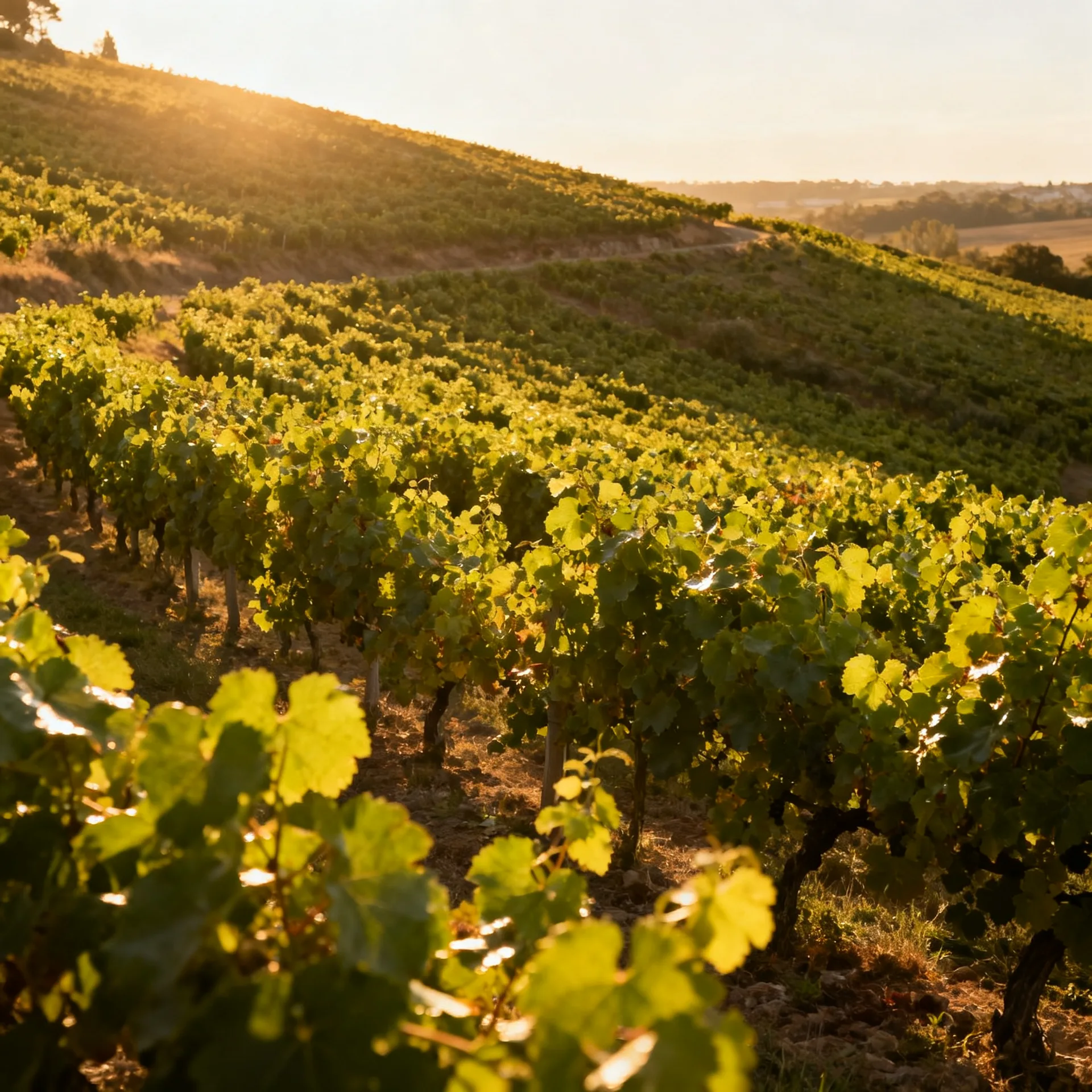
This approach also changes the soil. By doing away with synthetic molecules, we preserve the vineyard’s microbiome — the underground life that nourishes the vine. For us, this is not a constraint: it is the work of living organisms. That is why we speak of cultivation without synthetic pesticides on the limestone soils of Genté, rather than simply a list of prohibitions.
In other words: the quality of a distillate is determined first and foremost in the soil, long before it reaches the copper of the still.
What labels guarantee (and do not guarantee)
Faced with this issue, consumers look for a guide: a label. This is useful, but each label covers a different scope — and none of them says exactly the same thing about residues.
| Label / statement | What it guarantees | What it does not guarantee |
|---|---|---|
| Organic Farming (AB) | No synthetic pesticides permitted; regulated natural inputs (including copper and sulphur) | The total absence of any traces (environmental contamination, neighbouring plots) |
| HVE (High Environmental Value) | A comprehensive environmental approach across the farm | ‘Zero synthetic pesticides’: HVE is not the same as organic |
| Biodynamics | Specifications similar to those for organic farming, reinforced by preparations and adherence to natural rhythms | Analytical proof of the absence of residues in the finished product |
| ‘No residues detected’ | A laboratory analysis below the detection limit on a given date | No inputs used during cultivation (stated on the product, not in the method) |
A label should therefore be interpreted for what it actually certifies, not for what is assumed of it. We set out these nuances in detail in our comparison: organic, biodynamic, Holohoméopathie: what each label guarantees.
Our approach at Genté: having nothing to remove
Rather than seeking to eliminate residues at the end of the production chain, we have chosen not to introduce any in the first place. The best traceability is having nothing to remove.
On our Grande Champagne limestone soils, we work according to the principles of Holohoméopathie — the law of similars and dynamisation: an alternative to heavy-duty chemical treatments. It is an approach that seeks to strengthen the vines rather than impose a product, and which places life at the centre.
There is a reason behind this choice. It was Flavie’s realisation regarding plant protection products that shaped the estate’s entire approach.
FAQ
Does distillation remove pesticides from the grapes?
Not entirely, and not systematically. Distillation separates compounds according to their volatility. Less volatile molecules tend to remain in the stillage, but some volatile molecules may pass into the distillate. The still is no substitute for growing grapes without synthetic inputs at the outset.
Do spirits contain pesticide residues?
That depends on the grapes used and the specific molecules involved. There is less scientific literature on spirits than on wine. The decisive factor remains the raw material: grapes grown without synthetic pesticides will not contribute any synthetic substances to the distillate.
Does the organic label guarantee the total absence of pesticides?
The AB label prohibits synthetic pesticides, but it does not guarantee the absolute absence of any traces. Environmental contamination or the proximity of treated plots may leave very low levels of residues. Organic certification regulates the farming method, not an analytical result for every bottle.
Transparency as our sole argument
Our aim is not to judge others, but to be able to be fully open about what we do. Do you have a question about our practices? Ask us about our practices.
Flavie Aubineau
 Flavie & Virgile · Domaine de Genté