Grande Champagne, Petite Champagne: how geology shapes the flavour in the glass
Two neighbouring vineyards, two types of limestone deposited by ancient seas — and two eaux-de-vie that are as different as night and day. With vineyards in both Genté and Jarnac-Champagne, we explore what the Campanian and Santonian periods actually do to the vines, and then to the glass.
Key facts
- Grande Champagne and Petite Champagne are the two premier crus of the Cognac appellation, distinguished by their soil rather than by their boundaries.
- Two types of limestone formed from the same Cretaceous sea around 80 million years ago: the Campanian beneath Grande Champagne, and the Santonian beneath Petite Champagne.
- Limestone acts as a natural sponge: it drains water, releases it back into the soil, and subjects the vines to just the right amount of stress.
- The result in the glass: finesse and longevity on the one hand, and an earlier-developing floral roundness on the other.
- Our estate cultivates both crus, in Genté and Jarnac-Champagne — here we share our observations.
From the cellar in Genté, the view stretches out over white hillsides. Beneath our rows, chalk outcrops between the vines. It is this chalk that, long before we do, shapes the character of each eau-de-vie.
Why ‘Champagne’ in the heart of the Charentes?
The word often comes as a surprise. Nothing here has any connection with the region of sparkling wines, hundreds of kilometres to the north-east. The name comes from the Latin *campania*: the open plain, the land of light-coloured soil.
Throughout France, this word has been used to describe landscapes of soft chalk and sun-drenched countryside. The Charentes have their own version. Here, ‘Champagne’ refers to a type of rock: a pale, crumbly limestone that turns the paths white after the rain.
When the Cognac appellation defined its crus in 1938, it enshrined this geology in law. Six crus in concentric circles around the town of Cognac, from the limestone heart out towards the woods. At the centre lies the Grande Champagne, the premier cru of Cognac. Just to the south lies the Petite Champagne. The word speaks of the rock. The rock, in turn, speaks of everything else.
Campanian and Santonian: two types of limestone, two maritime histories
To understand the difference between Grande Champagne and Petite Champagne, we must go back to the Late Cretaceous period, some 80 million years ago. At that time, a warm, shallow sea covered the Charentes region.
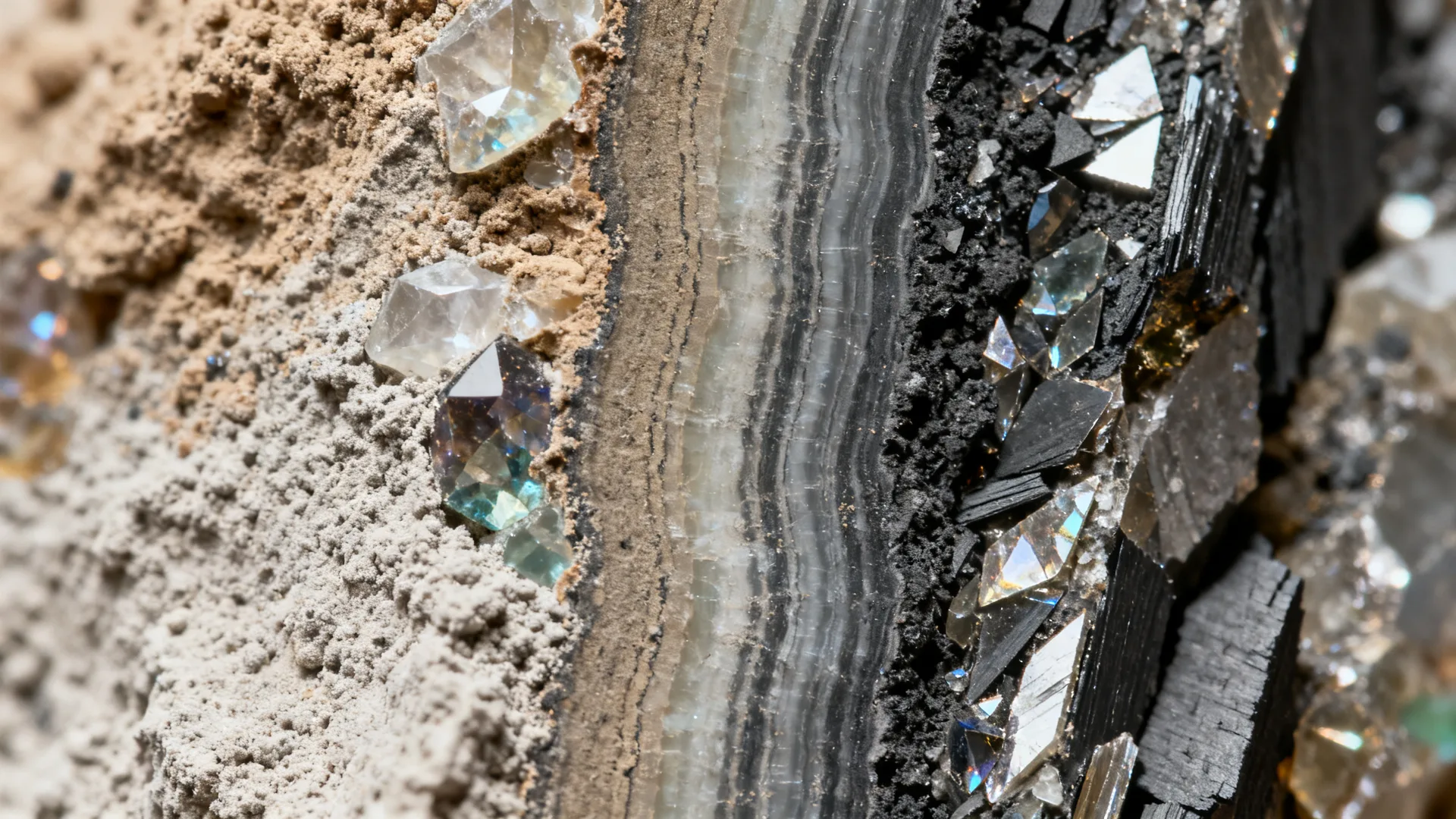
At the bottom of this sea, calcareous micro-organisms died and accumulated, season after season, over millions of years. Slowly, these deposits compacted into rock. It is this bedrock that the vines now explore with their roots.
But the sea did not deposit the same material everywhere. The geological strata follow one another like the pages of a single book, each with its own texture.
The Campanian of the Grande Champagne
Beneath the Grande Champagne lies the Campanian chalk. A soft, fine chalk, very rich in active limestone. It almost crumbles between your fingers. Deep and uniform, it allows the roots to reach far down in search of water.
The Santonian of the Petite Champagne
Beneath the Petite Champagne lies the Santonian, a slightly older stratum. The limestone here is often a little harder, more marly in places, and sometimes mixed with clay. The subsoil here is more varied.
These nuances may seem minute. A few metres of rock, a few degrees of hardness. Yet this is where the whole difference lies — for the minerality of a soil cannot be tasted: it is built up, step by step, throughout the life of the vine.
What the rock does for the vine
Limestone does not nourish the vine. It shapes it. Its primary virtue is that it acts as a natural sponge.
The porous chalk absorbs winter rainwater and stores it. When summer comes, it releases it drop by drop to the roots. Drainage is perfect: never too much, never a sudden shortage. This is what we call limestone’s role as a natural sponge and regulator of just the right amount of stress.
For the vine gives its very best when it suffers a little. Moderate water stress encourages it to concentrate its juices, producing more refined aromas rather than sheer volume. The Campanian chalk, which is deeply-seated and highly draining, imposes this stress with remarkable consistency.
For Ugni Blanc, the king of Cognac grape varieties, this makes all the difference. The grapes remain acidic, with low sugar content, but possess an aromatic purity that is ideal for distillation. This is precisely what the rootstock and bedrock negotiate beneath our feet, in the Holon, our living terroir in Genté, Grande Champagne.
On the more heterogeneous Santonian, water regulation remains excellent but expresses itself differently. The slightly clayier soils retain more moisture: the vines suffer less, ripening with greater roundness. Two schools of patience, for the same ‘Vivant’.
In the glass: finesse, rancio and length
There comes a moment when you can taste the rock. Not literally—we don’t drink limestone—but through what the vines, distillation and time have made of it.
Distillation acts here as a magnifying glass. The copper still, heated gently over a low flame, concentrates the grape’s identity. Distillation acts as a concentrator of the terroir’s identity: what the chalk has whispered to the vine, the brouillis reveals.
The profile of Grande Champagne
The Campanian yields eaux-de-vie of great finesse, but above all of exceptional longevity. When young, they seem almost austere, closed off. They need time in the cask to open up.
With the passing years come notes of vine blossom and lime blossom, followed by the famous ‘rancio’: that complex bouquet of nuts, leather and spices that is the hallmark of great aged cognacs. Grande Champagne is made to last for decades.
The profile of Petite Champagne
The Santonian sub-region often produces Cognacs that are more floral, rounder and accessible sooner. The finesse here is immediate and graceful, with a delicate aromatic structure. Whilst Grande Champagne bides its time, Petite Champagne is already charming.
Neither is superior to the other. They are two distinct temperaments, two paces, two ways of interpreting the same limestone alphabet.
One estate, two terroirs: what we see in Genté and Jarnac-Champagne
Our good fortune, and what makes us unique, lies in these two locations. In Genté, in the heart of Grande Champagne, on Campanian chalk. In Jarnac-Champagne, in Petite Champagne, on Santonian chalk. Fifteen kilometres separate these plots. A whole world lies between them.
When we work these two terroirs with the same intention, without chemicals, attuned to the rhythms of life, the differences do not fade away. They reveal themselves. The same hand, the same gesture, two types of rock — and two eaux-de-vie that are unmistakably distinct.
In Genté, the vines seem more taut, more upright. In Jarnac-Champagne, they are more generous, more enveloping. We do not force anything: we listen to what each chalky soil has decided, then we guide the process. This is the foundation of our Cognac d’Auteur — a Cognac that embraces its plot of origin rather than masking it.
For us, working with the two crus side by side is the best learning experience. Each cuvée from one sheds light on the other. To explore further, we invite you to discover Holon, our living terroir in Genté in Grande Champagne.
And what about Fine Champagne?
The term often raises questions on labels. Fine Champagne is not a separate cru: it is a blend. More precisely, an exclusive blend of Grande Champagne and Petite Champagne.
The appellation’s rule is clear: to bear the ‘Fine Champagne’ designation, the blend must contain at least 50 per cent Grande Champagne. It is, in short, the marriage of our two terroirs in a single glass — the longevity of one, the roundness of the other.
Comparison table: Grande Champagne vs Petite Champagne
| Criterion | Grande Champagne | Petite Champagne |
|---|---|---|
| Subsoil | Soft chalk, active limestone, homogeneous and deep | Harder limestone, sometimes marly and clayey |
| Geological age | Campanian (Upper Cretaceous, approx. 80 million years ago) | Santonian (Upper Cretaceous, slightly older) |
| Aromatic profile | Delicate, vine blossom, lime blossom, rancio on ageing | Floral, round, graceful, accessible earlier |
| Ageing | Very long, built to last for decades | Opens up earlier, develops beautifully over the medium term |
| Our vineyard plot | Genté (16130) | Jarnac-Champagne (17520) |
FAQ
What is the difference between Grande Champagne and Petite Champagne?
These are the two premier crus of Cognac, distinguished by their subsoil. Grande Champagne rests on deep, soft Campanian chalk; Petite Champagne on harder Santonian limestone. The former produces eaux-de-vie suitable for long ageing, whilst the latter yields more floral and early-maturing profiles.
Why are these regions called ‘Champagne’?
The name comes from the Latin ‘campania’: an open plain with light-coloured chalk soils. It has no connection with the region famous for its sparkling wines. In Charentes, ‘Champagne’ simply refers to the limestone nature of the terroir, a term enshrined in the appellation in 1938.
Does a Fine Champagne Cognac necessarily come from Grande Champagne?
Not entirely. Fine Champagne is a blend of Grande Champagne and Petite Champagne, with at least 50 per cent Grande Champagne. It is therefore a blend of the two crus, rather than the expression of a single one.
Why do Grande Champagne Cognacs age for longer?
The Campanian chalk subjects the vines to regular water stress, which concentrates the aromas and acidity. The eaux-de-vie produced from these grapes are structured and closed when young: they require many years in oak barrels to develop their finesse and rancio.
The chalk speaks; we listen
Beneath our two terroirs lies the same Cretaceous sea, now turned to rock. Learning to read its nuances means learning to respect the living organisms that take root there. Do you have any questions about our soils? You can ask us about our Charente terroirs or come and walk on this chalk yourself – visits are by appointment.
 Flavie & Virgile · Domaine de Genté