Vineyard Diary — Summer in Genté: flowering, fruit set and care through the infinitely small
The first instalment of our field diary. In mid-June, the vines smell of lime blossom: the flowers are opening, and fruit set will follow. What really happens in the vineyards during the summer, and how we support this process on an infinitesimally small scale, without the use of synthetic chemicals.
Key points
- The flowering of the vines lasted only a few days in Genté, around mid-June — a brief window that determines a large part of the harvest.
- This is followed by fruit set: each fertilised flower becomes a tiny berry.
- Meanwhile, we walk the rows to prune the vines, kilometres of work carried out by hand.
- We support these stages with the minutest of care, without ever claiming to control everything — the vine remains the living entity that makes the decisions.
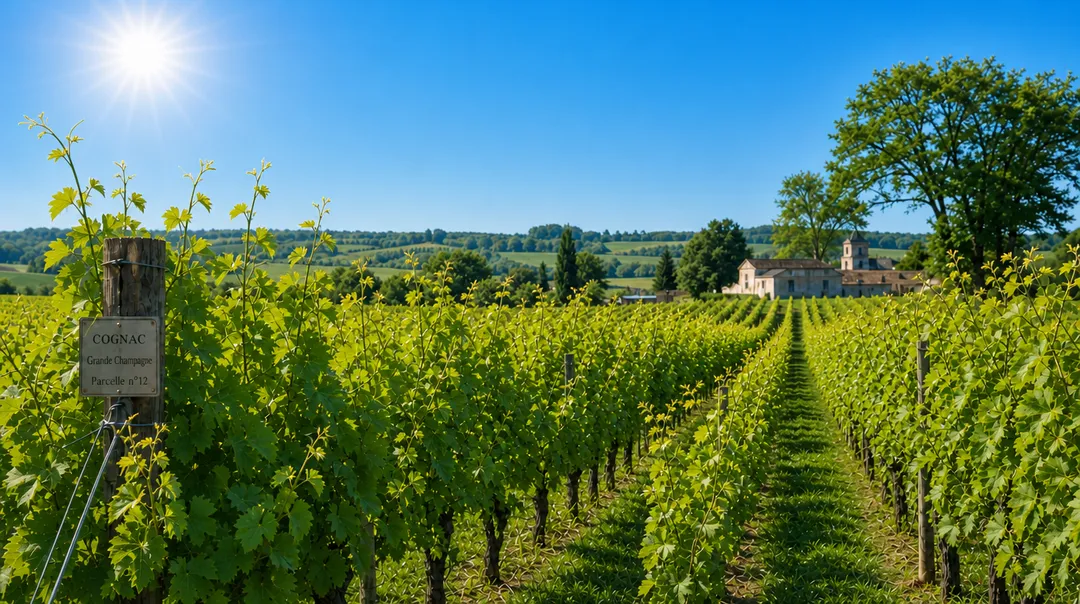
In mid-June, when we enter the rows in the early morning, the air has changed. A delicate, almost sweet scent wafts between the vines — a fragrance of lime blossom and cold honey. This is the sign we’ve been waiting for: the vines are in bloom. Here is the first instalment of our Vineyard Diary, told from our plots in Genté, in Grande Champagne.
Flowering: a few days that decide everything
We often picture showy flowers. The reality is more understated. The vine flower is tiny: a floral cap opens, releasing the stamens, and fertilisation takes place almost silently. For most of our grape varieties, pollination is self-fertilising — the flower fertilises itself. From one plot to the next, the varieties do not all come into bloom at the same time.
This window is brief, and that is where the challenge lies. A few hot, dry days, and full bloom is over within a week. A cold snap, heavy rain or damp wind, and fertilisation is compromised. Almost everything is decided within this window. We watch for it every year with the same sense of anticipation.
When does the vines’ flowering take place?
In Charente, flowering generally takes place in the first fortnight of June, once the warm weather has set in. In Genté, it happens over the course of a few days, once the warm weather has set in. The date varies each year depending on how early spring arrives and the grape varieties.
How long does flowering last?
On a single plot, full bloom rarely lasts more than a week when the weather is mild. In cool and unsettled weather, it can stretch out over a longer period, which makes pollination more fragile. It is precisely this brevity that makes the period so crucial for the future harvest.
[PHOTO 1 — Close-up of a vine flower]
From flower to berry: fruit set
Once the flower has been fertilised, it transforms: the ovary swells and becomes a tiny, hard, green berry. This is fruit set. Within a few days, our withered inflorescences give way to small, tightly packed bunches, barely larger than a pinhead. It is one of the most moving moments of the year — you can literally see the grapes begin to form.
What is fruit set?
Fruit set refers to the transition from a fertilised flower to a young berry. Each flower that ‘sets fruit’ will produce a berry; the others fall off. The quality of this stage determines the number of berries per bunch and, therefore, in part, the volume and balance of the harvest.
Not everything is successful, and that’s normal. When fertilisation takes place under poor conditions, two phenomena occur: coulure, when flowers fall off without producing berries, and millerandage, when berries remain small and seedless. Every year, we watch for these signs, bunch by bunch. We observe, we make notes, and we let the vine adjust its yield.
Trellising: kilometres of manual labour
Whilst the bunches are forming, the vine grows quickly — very quickly. The shoots grow several centimetres a day and sprawl in all directions. This is the time for training: we straighten the shoots and thread them through the training wires to keep the vines in order. It is a simple task, but one that goes on endlessly, row after row.
[PHOTO 2 — Training the shoots by hand]
What is training and why is it important?
Training involves guiding the shoots vertically along the trellis. When done properly, it aerates the foliage, exposes the leaves to more light and reduces moisture around the bunches. It is one of the essential summer pruning tasks, on a par with trimming and leaf removal.
We carry out this task by hand, slowly. It’s tiring, but invaluable: walking down each row also allows us to take the pulse of the vineyard. We can feel by touch whether a vine is vigorous or stressed, and we can spot what’s going well and what needs attention. No sensor can replace this physical presence amongst the vines.
Supporting the vine through the infinitely small
This is the very heart of our approach. At this stage of growth, we support the vines through Holohoméopathie: preparations in dynamised dilutions, infinite in number and imbued with intention. The idea is not to force the plant, but to support its own ability to develop and find its balance.
To put it simply: we do not claim to cure anything, nor to protect the vine 100 per cent. Life itself remains in control. Our role is a more humble one — to observe first, then intervene, and only if our observations warrant it. Before each visit, we look at the colour of the leaves, the condition of the bunches, the life in the soil, and the weather forecast. It is observation that decides, not a rigid schedule.
For us, this logic of the infinitely small embodies the coherence of the entire Holon: a place that we support rather than constrain. If this approach intrigues you, we explain it in detail in ‘Holohoméopathie pendant la période de croissance: renforcer la capacité de la vigne à se développer’. Et pour découvrir où tout cela se déroule, voici le Holon, notre site de production à Genté.
Understanding our method → our Holohoméopathique approach
What we observe between the rows
A vineyard diary isn’t just about the vines. What tells us the most, in fact, is what grows and lives around the vines. As spring draws to a close, the space between the rows is a little world of its own: ground cover, wildflowers, insects, and a whole discreet community that we sense rather than see.
[PHOTO 3 — Lively space between the rows and biodiversity]
We also keep an eye out for lichen on the old vines and stakes — for us, a sign of clean air and a symbol dear to the estate. Its presence speaks of balance. And beneath our feet, the soil works in silence: the millions of micro-organisms beneath each vine—mycorrhizae and rootlets—weave the invisible web from which the vine draws its nourishment. It is this very life, accumulated season after season, that finds its way into the grape. To show how the estate fares during the warmer months, we also describe summer at Holon: the foliage and biodiversity amongst the rows.
[PHOTO 4 — Lichen on a vine]
The summer calendar
| Period | Stage | What happens |
|---|---|---|
| Early June | Flowering | The flower caps fall off; fertilisation takes place over a few days. |
| Mid-June to late June | Fruit set | The fertilised flowers develop into small green berries. |
| July | Cluster closure | The berries grow larger and come into contact with one another; trellising and green pruning are in full swing. |
| Late July to August | Veraison | The grapes change colour and texture; ripening begins. |
FAQ — the vineyard in summer
Why do winegrowers monitor flowering so closely?
Because it determines the forthcoming harvest: it is during this short window that pollination takes place, and thus the future number of grapes is determined. A few days of bad weather can cause coulure or millerandage and reduce the potential yield.
Should the vines be treated during flowering?
Here, our rule is to observe before acting. We support the vines with dynamised dilutions to maintain their balance, without a rigid routine or synthetic chemicals. Every intervention is based on what the plot shows us, never on a fixed schedule.
What is green pruning?
These are interventions on the vegetation during the growing season: lifting, trimming and leaf removal. They aerate the vines, improve light exposure and limit moisture around the bunches. Carried out by hand, they are also a way for us to stay in close contact with each row.
Looking ahead to the harvest
Here’s where we are in mid-July: the bunches are closing up, the lifting is drawing to a close, and the vines are heading towards veraison. The next instalment of the Journal will take us to autumn 2026 — the harvest, followed by the first distillations in the still, when the Holon grapes are turned into brandy. To make sure you don’t miss it and to follow the rest of the adventure, sign up to receive the next instalment of the Journal.
 Flavie & Virgile · Domaine de Genté