Homeopathy for plants: how do you treat a vine with the infinitely small?
Law of similars, dilution, potentisation: what homeopathy actually is, how it is applied to a vine, and what holohomeopathy adds by changing scale. An honest explanation — including about what this approach does not claim to be.
The essentials in 30 seconds
- Homeopathy rests on two principles: the law of similars and the potentised dilution.
- Applied to plants, it is called plant homeopathy or agrohomeopathy: a vine has neither belief nor expectation, which makes the placebo objection inoperative — without settling the scientific debate for all that.
- Holohomeopathy changes scale: it does not treat an isolated plant, but the whole ecosystem, the Holon.
- Here we explain what this approach does — and what it does not claim to do.
"You do homeopathy… on vines?" That is the question that comes back every time, often with a polite smile. It is a fair one. So let us take the time to answer seriously: what homeopathy is, how it is applied to a plant, what holohomeopathy adds to it, and where what can honestly be asserted stops.
Homeopathy, in two principles
Homeopathy was born at the end of the 18th century, driven by the German physician Samuel Hahnemann. It stands on two pillars, and both must be understood to understand what follows.
1. The law of similars
Similia similibus curantur: "like is treated by like". The founding intuition is this: a substance which, at an ordinary dose, causes certain disorders in a healthy organism may, at a minute dose, help that same organism respond to comparable disorders.
This is not a logic of combat. The aim is not to destroy an aggressor. The aim is to send a signal that triggers a response already present in the organism. The difference is fundamental, and it is what separates homeopathy from all the chemistry we have left behind.
2. Dilution and potentisation
The second pillar is the most counter-intuitive. The starting substance is diluted, again and again, in water. Then — and this is the essential gesture — the vial is shaken vigorously at each stage. This rhythmic shaking has a name: succussion, or potentisation.
Beyond a certain threshold of dilution, not a single molecule of the initial substance remains. That is a fact, not an opinion. For homeopathy, it is no longer the molecule that acts, but the imprint that potentisation is said to have left in the water. You leave the ground of matter for that of information.
Let us say it straight away, because this is the crux: it is precisely this point that conventional science disputes. The mechanism by which water without an active molecule would carry information remains without any explanation accepted by the scientific community. We are not going to pretend otherwise. We will come back to it.
Can you really do homeopathy on a plant?
This is where the subject becomes genuinely interesting.
The most widespread objection to homeopathy is that of the placebo effect: the patient gets better because they believe in the treatment. It is a strong argument, and it deserves to be taken seriously.
Except that a vine believes nothing. It expects nothing, reads no label, holds no opinion on what is sprayed on its leaves. That is what makes plant homeopathy — or agrohomeopathy — experimentally interesting: it places the debate on ground where the subject's expectation does not exist.
Be careful, though, not to turn that remark into proof. The absence of placebo does not establish efficacy; it merely rules out one explanation. All the other factors remain: the weather, the state of the soil, the vigour of the vintage, and our own attention as growers — because a grower who applies a preparation is a grower who has walked their rows, and that alone already changes a great deal.
We would rather put it this way: we cannot explain everything, we know what we observe.
What does a preparation actually look like?
Let us leave theory behind. Here at Genté, a preparation does not come down from a catalogue. It starts from the estate itself.
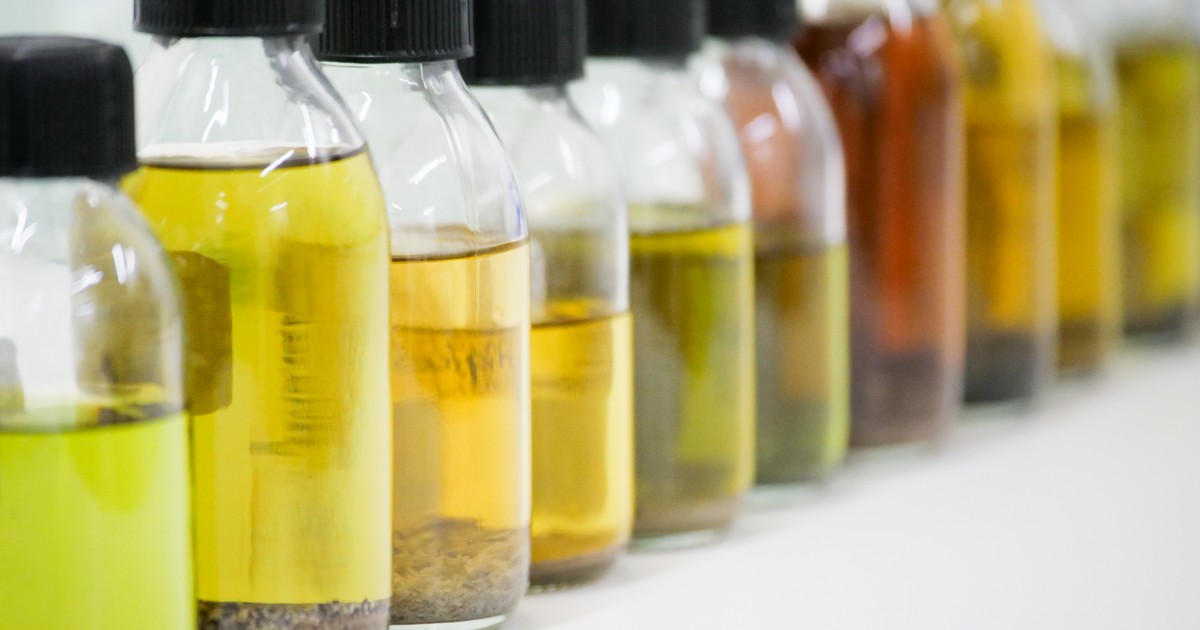
We gather the raw material on site or nearby: plants, seaweed, fungi, mineral elements. The gathering and the making are collective work — here, the whole family lends a hand. That material is then diluted and potentised in our laboratory, following a precise protocol.
The principle that governs all the rest fits in one sentence: we apply no outside input. No fertiliser, no synthetic pesticide, and not even the natural treatments the organic specification allows, such as copper. What the vine receives comes from its own world.
Then comes the most important thing: timing. We do not follow a treatment calendar. Every intervention starts from an observation — the state of the foliage, the life between the rows, the rain on its way, the balance of the canopy. The gesture answers what the plot expresses. That is exactly what we tell, season after season, in our vine journal.
Take a problem gently, and you get a gentle answer.
From homeopathy to holohomeopathy: changing scale
Had we stopped at plant homeopathy, we would simply have swapped one vial for another. Treating a sick vine with a dilution rather than a molecule is still reasoning in terms of symptoms.
Holohomeopathy takes a decisive step sideways: it does not see the vine as an individual, but as part of a living whole. That whole has a name — the Holon. The soil, the water, the fungi, the insects, the hedges, the micro-organisms, the vine, and us. A single organism.
Three practical consequences follow.
You treat the system, not the symptom
An attack of downy mildew is not a problem to be eliminated, it is information about an imbalance. The question is not "how do we kill the fungus", but "what, in this system, made it possible". The answer is almost always in the soil, rarely on the leaf.
You respect the rhythms
The flow of sap, the vitality of the fruit, the microbial activity of the soil follow cycles. We fit our work into those timeframes rather than those of the diary. From a distance, it looks like what biodynamics does — but the two approaches are not aiming at the same thing, and we have taken the time to compare organic, biodynamics and holohomeopathy honestly.
The human being is part of the system
This is the point we are criticised for most, and the one we hold to most. The farmer is not outside the Holon: their attention, their presence and their intention are part of it. You can see poetry in that. What we see above all is a demand: whoever walks their rows every day sees what a calendar will never see.
The full approach is set out on our Holohomeo page, and the place where it is applied can be visited on the Holon page.
Fractality: measuring how the living builds itself
An honest question deserves an attempt at a measurable answer. How do you know a living system is doing well?
The lead we are following is called fractality: a measure of a system's capacity to build itself. When it is low, the system runs out of breath and degrades. The more of it there is, the greater the potential for life. Its interest is that it can be measured at every scale — from the soil to the plant, from the fruit to the finished product.
This work was presented at the International Health Congress in Prague, from 3 to 5 October 2025. It guides our processes today. It does not, at this stage, amount to validation by the scientific community in the usual sense of the term, and we will not let anyone believe otherwise. [À VALIDER]
What this approach does not claim to be
It seems more useful to set the limits ourselves than to let others set them.
- It is not a medicine. We make no therapeutic claims for our juices, our wines or our future eaux-de-vie. For us, distillation is a technique for organoleptic quality, nothing else.
- It is not an established science. The mechanism of high dilutions remains debated, and we will not settle it from a row of vines in the Charente.
- It is not a label. Holohomeopathy has no official certification. Our only guarantee is the transparency of what we tell.
- It is not a criticism of others. Organic removes, biodynamics accompanies, holohomeopathy awakens. Three roads, one same horizon.
What we do assert, on the other hand, is verifiable: no synthetic chemical input touches our soils. What the vine does not receive, the grape does not keep — and that, in itself, is already an answer to the question of residues in the glass.
FAQ — your questions about plant homeopathy
What is plant homeopathy?
It is the application of the principles of homeopathy — the law of similars and the potentised dilution — to plants rather than to humans. It is also called agrohomeopathy. Instead of treating a pest, the aim is to trigger the plant's own immune response through an infinitesimal signal.
What is the difference between plant homeopathy and holohomeopathy?
Plant homeopathy addresses the plant. Holohomeopathy addresses the whole ecosystem, called the Holon: soil, water, fauna, flora, vine and human included. The first treats an individual, the second harmonises a system. It is a change of scale, not of technique.
Is homeopathy on plants scientifically proven?
No, not in the sense of a scientific consensus. The mechanism of high dilutions remains without any explanation accepted by the scientific community. The placebo objection does not apply to a plant, which makes the field experimentally interesting, but that does not establish efficacy for all that. We would rather say what we observe than what we cannot demonstrate.
Do you use copper or sulphur, as in organic farming?
No. The organic specification allows them, our approach does not use them. The principle is that no outside input is applied: our preparations come from the estate itself.
What happens if a disease breaks out anyway?
We look for the cause in the system rather than the remedy on the leaf: the state of the soil, the balance of the canopy, microbial life, excess vigour. This approach is slower and riskier than a curative treatment. We accept that, and we tell it — including in the years when it costs us.
Listening rather than constraining
Homeopathy applied to the vine is not a magic wand, and holohomeopathy is not a religion. They are ways of asking a different question: not "how do we silence this problem?", but "what does this problem say about the system?".
We have no certainty to sell. We have a method, a piece of land, a family and ten years of trials — many of them mistakes. If this way of looking at the living world intrigues you, step into the method, or come and ask us your questions. The best ones often come from those who doubt.
Flavie Aubineau
 Flavie & Virgile · Domaine de Genté